
Welcome, and thank you for visiting my modest gallery tucked away in a quiet corner.

Here you will find a variety of my works—large and small, diverse in character and spirit. I arranged them in this way because, seen together, they may give you a clearer sense of who I am.

To be honest, I often feel my lack of formal training and the limited time I have been able to devote to art. Yet I continue without pause—feeling, learning, and growing in the process.

I am not a master of any single field, nor do I belong wholly to any place. Take what you see as it is, and carry with you whatever impressions remain. Though I began in earnest later in life, I have always sought to keep faith with my first intent—to let neither results nor criticism define me, but to follow the quiet integrity of my own path in art.

At times, a sudden impulse led me to submit small works to competitions, and a few were recognized. In Korea, I once taught art at a high school for about ten years. In 2009, after twenty years of living in Australia, I returned to Korea, where I now work as a sculptor. That, in essence, is the whole of my artistic journey.

I have no interest in heavy philosophy. What moves me are the kinds of impressions that feel like music, and the vivid realities that the world tirelessly brings forth.

I love travel and every kind of documentary, and hold special respect for the creators of BBC Earth, whose programs I watch with admiration. And one thing is certain: without music, I imagine my veins would carry nothing but plain water.

Perhaps artists are simply those who live in the busy square between the entrance of expectation and the exit of fulfillment.

Even if you arrived here by chance, I am grateful.

Yoonki Hong
Born 1952

ADORE-GALLERY
85 Cheongun-ro, Mungyeong-eup, Mungyeong-si Gyeongsangbuk-do, Republic of Korea

Blog

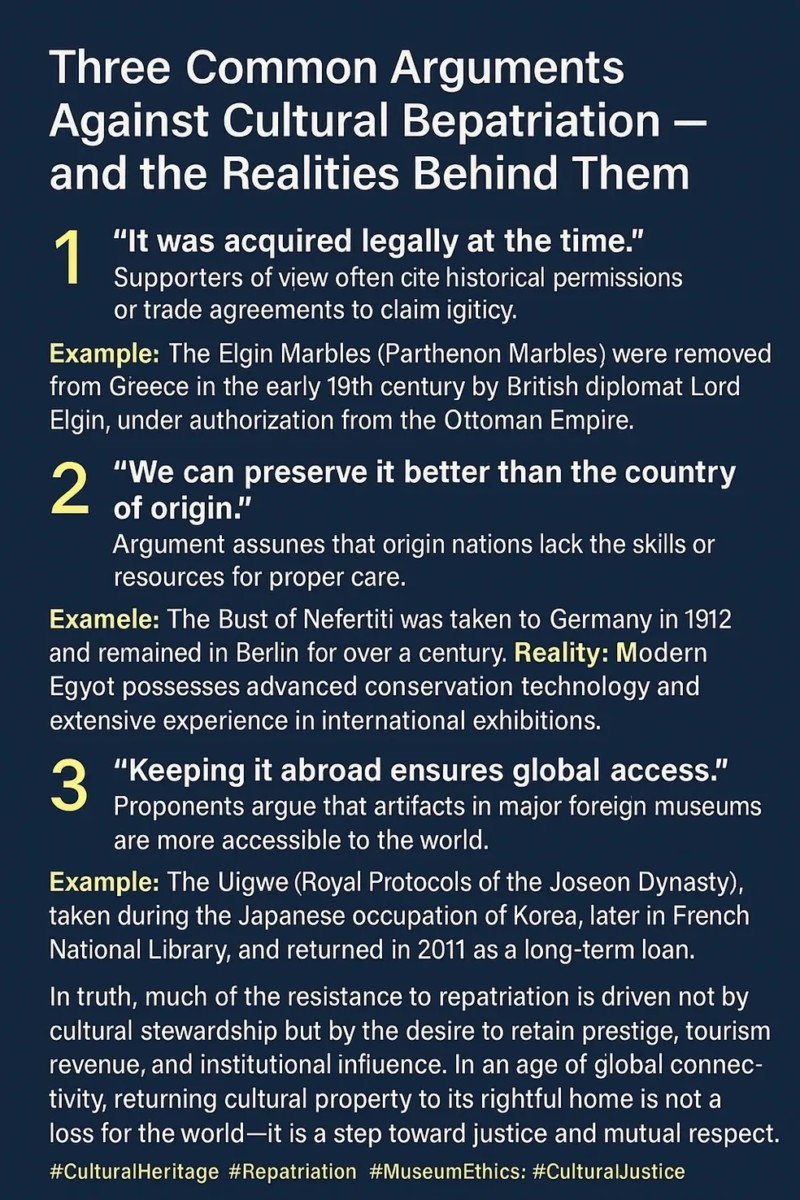
THREE COMMON ARGUMENTS AGAINST CULTURAL REPATRIATION — AND THE REALITIES BEHIND THEM

1 “It was acquired legally at the time.”
Supporters of view often cite historical permissions or trade agreements to claim igiticy.

Example: The Elgin Marbles (Parthenon Marbles) were removed from Greece in the early 19th century by British diplomat Lord Elgin, under authorization from the Ottoman Empire.

2 “We can preserve it better than the country of origin.”
Argument assumes that origin nations lack the skills or resources for proper care.

Examele: The Bust of Nefertiti was taken to Germany in 1912 and remained in Berlin for over a century.
Reality: Modern Egypt possesses advanced conservation technology and extensive experience in international exhibitions.

3 “Keeping it abroad ensures global access.”
Proponents argue that artifacts in major foreign museums are more accessible to the world.

Example: The Uigwe (Royal Protocols of the Joseon Dynasty), taken during the Japanese occupation of Korea, later in French National Library, and returned in 2011 as a long-term loan. In truth, much of the resistance to repatriation is driven not by cultural stewardship but by the desire to retain prestige, tourism revenue, and institutional infiuence. In an age of global connec- tivity, returning cultural property to its rightful home is not a loss for the world —it is a step toward justice and mutual respect.

POST A COMMENT